monstertov@dental-care-malware
DLL sideloading · process hollowing · blockchain c2 · monero mining · RDP brute-forcing
A Signed Launcher With One Wrong DLL
a dental practice workstation started brute-forcing RDP on the internet. the cause was a CBCT x-ray export named cbct_xray_2026-10-09_0745.zip. it did not arrive as an attachment: the lure was a patient inquiry by e-mail with a SwissTransfer download link, opened at the reception desk.
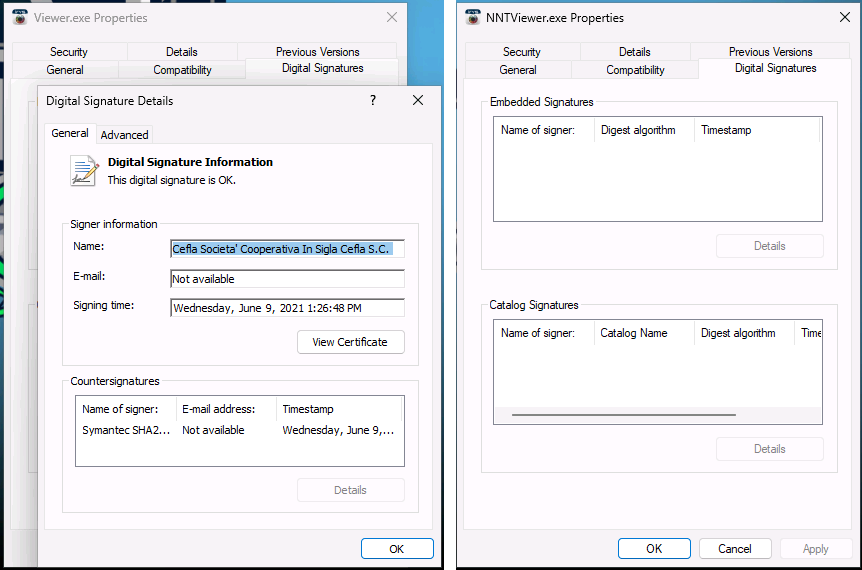
the export contained a NewTom (CEFLA) CBCT viewer. only its launcher, Viewer.exe, is signed by CEFLA and verifiably unmodified. the viewer itself, NNTViewer.exe, is unsigned: its version info names CEFLA, but without a signature that cannot be verified. one file inside it was replaced: Viewer\glew32.dll, swapped for a malicious proxy. two more sit next to the 3d model files: Viewer\Lib3D\primitives\cat.3ds and dog.3ds. instead of showing the scan, the proxy decodes two payloads that shipped inside the same archive, drops them, and the viewer exits with a fake windows 11 error.
this writeup covers how the infection was observed, how the chain works and why the lure fits the target so well. it contains no victim details and no addresses of hosts that were attacked.
How It Was Observed
firewall session tables showed one internal host holding hundreds of outbound TCP 3389 sessions to random internet addresses, plus a steady session to a host on TCP 8080. blocking those two patterns stopped the abuse reports, but not the infection.
the EDR storyline on that host tied everything back to one parent process: NNTViewer.exe, started from a folder inside the user's Pictures directory. from there the file events, scheduled tasks and network connections could be followed in order.
per-process network accounting (SRUM) confirmed the split afterwards. the scanner accounted for about 40 GB sent and 45 GB received over 18 working days. the injected explorer.exe moved under 10 MB in total, in a steady stream of small stratum messages without spikes.
Why the Lure Works
CBCT is a 3D x-ray scan used for implants, wisdom teeth and root-canal work. many practices do not own a CBCT scanner and refer patients to a radiology centre or oral surgeon.
the scan comes back as an export with a standalone viewer bundled, because 3D DICOM data needs dedicated software. the export layout looks like this:
Autorun.inf              open = Viewer.exe
Viewer.exe               CEFLA-signed launcher
Viewer\
  NNTViewer.exe          unsigned
  glew32.dll             <- replaced
  Qt5Core.dll
  Document\<study-id>.*  x-ray data files
  Lib3D\primitives\
    cat.3ds              <- payload, XOR-encoded
    dog.3ds              <- payload, XOR-encoded
  ...
for reception staff, receiving a package like this and double-clicking Viewer.exe is routine work. nothing about the interaction is unusual.
the lure does not need an exploit. it reuses the normal workflow and a trusted, signed launcher.
The Sideload
Viewer.exe starts Viewer\NNTViewer.exe. NNTViewer.exe loads glew32.dll from its own folder, which is the standard windows DLL search order for non-system libraries.
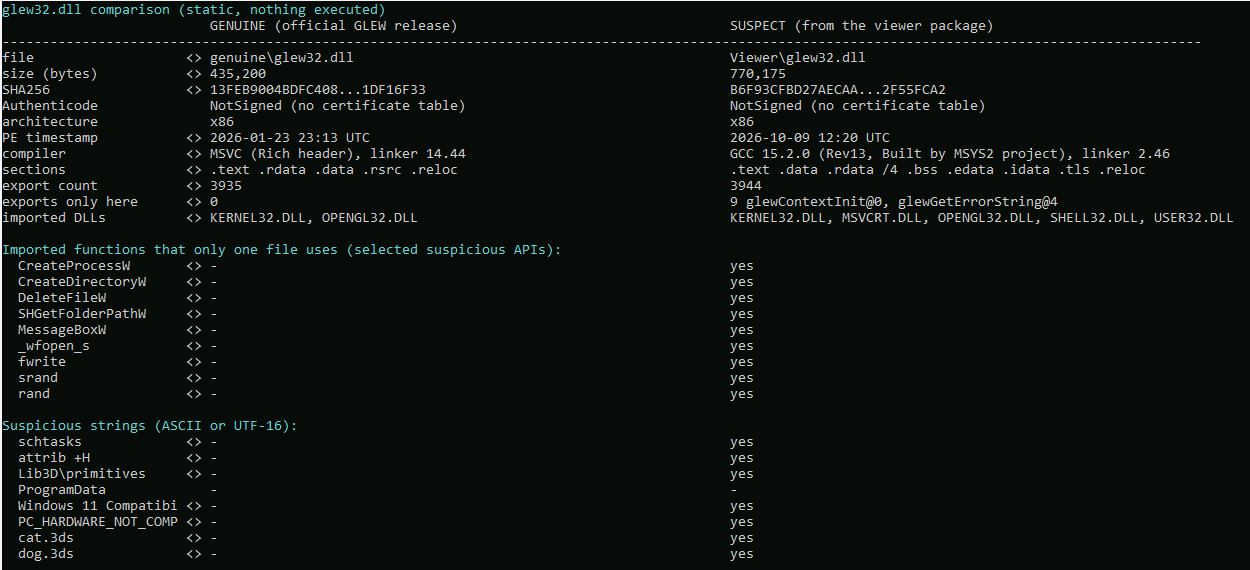
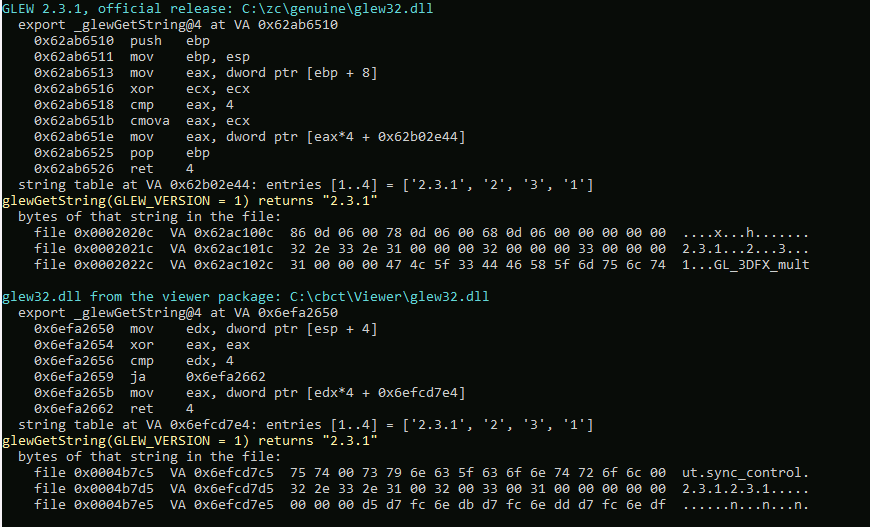
the malicious glew32.dll is a proxy. it exports all 3935 functions of genuine GLEW 2.3.1 (3944 counting 9 MinGW aliases), so the import table resolves and the load does not fail. but it never hands control back to the renderer. on load it runs its own code, decodes and drops the two payloads, and the viewer never shows a scan: a fake windows 11 error dialog appears and the process exits.
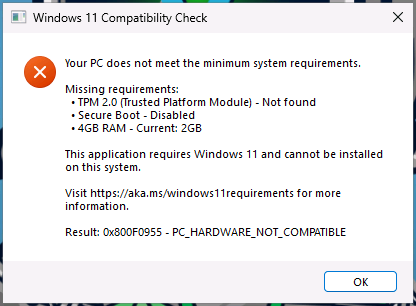
some details stand out in the package itself:
| file | detail |
|---|---|
| Viewer.exe | CEFLA-signed, signature valid and timestamped, file unmodified |
| NNTViewer.exe | unsigned. version info names CEFLA (NNT 16.6.0.11), not verifiable without a signature. this is the process that loads glew32.dll |
| glew32.dll | compiled 09-10-2026 12:20 UTC, file dated 09-10-2026 |
| rest of the package | dated 17-03-2026 |
| cat.3ds / dog.3ds | the two payloads, XOR-encoded with a 64-byte key |
| Qt5Core.dll | HashMismatch: the Qt installer patched its install path (qt_prfxpath) into the file after signing, and the file carries the original package date. most likely a vendor build artefact, not the attacker |
the date mismatch is the easiest static tell. every file in the export shares one date except the three the attacker touched: glew32.dll (15:20) and both .3ds files (15:19), all on 9 October. the lure went out the next morning.
The Payloads
the two payloads are not downloaded. they ship inside the archive as Viewer\Lib3D\primitives\cat.3ds and dog.3ds, XOR-encoded with a 64-byte key. glew32.dll decodes them while copying them to two executables in random folders under C:\ProgramData, then hides them with attrib +H +S:
C:\ProgramData\6fu939tzalgf6e9\heqpzkthv.exe
C:\ProgramData\czte0n2se0k8599awzjj\pmdc2rlzsw8jjjku2vcy.exe
the folder and file names are 5 to 20 characters from a-z and 0-9, and they are reproducible from the drop time, not random per se.
persistence is a scheduled task per payload, created in user context. the command line is present as a string in glew32.dll:
schtasks /f /CREATE /TN "%hs" /TR "%ls" /SC MINUTE /MO 2each task carries the payload name and runs every 2 minutes. there is no service, no run key and no admin requirement.
The Injector
pmdc2rlzsw8jjjku2vcy.exe is 714,196,992 bytes. about 705 MB of that is a single section of junk x86 instructions, not zero-padding, to defeat scanners and emulators and to push the file past scanner size limits.
every 2 minutes the task starts it. it spawns a fresh explorer.exe, hollows that process and runs the implant inside it (windows attaches its own console host to the injector, hence the conhost child):
pmdc2rlzsw8jjjku2vcy.exe
  ├─ conhost.exe 0xffffffff -ForceV1
  └─ explorer.exe            <- hollowed, runs the implant
an explorer.exe whose parent is not the shell, making outbound connections, is the clearest behavioural indicator in the whole chain.
the injector recovered from this archive is not the same binary the EDR recorded on the victim. the scanner is byte-identical to the archive copy, but the injector differs, and that difference is not yet explained.
The Implant
the hollowed explorer.exe is the implant. recovered and unpacked, it is two things: a SOCKS5 proxy and a hidden Monero miner (RandomX). it listens for SOCKS5 on TCP 1080 (username and password required) and mines to xororand.ru:8080 (193.233.138.30) over TLS.
the SOCKS5 side supports CONNECT and UDP ASSOCIATE, which turns the workstation into a relay. the miner speaks the usual stratum protocol: login, job, submit, keepalive.
it has no command channel. there is no tasking, no shell, no file transfer. its only network behaviour is the miner's stratum traffic, the SOCKS relay, and the blockchain lookups it uses to find its C2 (below).
what it does not contain is as important as what it does. the EDR recorded SAM queries, SetHook API keyboard hooking, a root certificate being added, LDAP password spraying and Kerberoasting on the victim's process tree. the implant recovered from the archive has no code for any of that. combined with the injector mismatch above, the behaviours the EDR saw do not line up with the sample in hand, and that gap is open.
The Scanner
heqpzkthv.exe is the RDP brute-forcer, and it is byte-identical to the copy in the archive. it runs 65 threads. it does not fetch a target list from anywhere: it picks its own targets and reports results back.
the flow looks like this:
random public IPv4
        |
X.224 probe on TCP 3389 (130 ms timeout)
        |
open hosts go to a queue
        |
up to 3 x 226 login attempts (5-15 min)
        |
valid login -> POST /api/result to 193.233.233.102:8082

separately, every 10 s: POST /api/stats
193.233.233.102:8082 is where results and stats are posted. it is not where work comes from: the scanner never reads anything back from it. the endpoint served a web panel with a login page at the time of analysis:
http://193.233.233.102:8082/login?next=http://193.233.233.102:8082/the targets were spread across cloud and residential ranges worldwide. they appear to be victims, not attacker infrastructure, so they are left out of this writeup.
Finding the C2 on a Blockchain
the implant does not carry its C2 address. it reads it from a dead-drop: a log event emitted by smart contracts. the lookup goes through public RPC nodes and the Blockscout API: eth_blockNumber then getLogs against the contract, read the events, decrypt the payload, connect to the address it names. every entry is signed by the operator (ECDSA), so nobody else can push a config. the operator can rotate the C2 by emitting a new event, without touching the malware. all four entries ever published decrypt to the same mining config: xororand.ru:8080, TLS on, RandomX rx/0 and rx/2. the config can only change pool and miner settings, not issue commands.
of the chains scanned, only Ethereum and Polygon emit this event. a scan of the full history of Ethereum, Polygon, Arbitrum, Optimism and Avalanche, plus the recent window of Base, found no other variants. this is one campaign's infrastructure, not a shared kit with many deployments.
the operator wallet that maintains the contracts sent 6 transactions on Ethereum and 4 on Polygon, and never transacted on BSC, Base, Arbitrum, Optimism or Avalanche. the most recent config update landed the evening before the lure was sent.
the design resembles the known EtherHiding families, but it is not one of them: the contract layout, the event and the encryption differ. there is no public reporting on this wallet, these contracts, the event or the function.
scope note on this part: BSC and Base before July were not scanned, because that needs a paid archive node. nothing in the scanned ranges contradicts the single-campaign reading, but those two windows are a gap.
How the Layers Are Decrypted
there are three separate encryption layers in the chain:
| layer | scheme | where |
|---|---|---|
| archive payloads | XOR with a 64-byte key | cat.3ds / dog.3ds, decoded by glew32.dll on load |
| implant strings | per-string additive encoding | decoded in memory on first use |
| blockchain C2 config | ECIES (secp256k1 + AES-GCM) | the event payload read from the contracts |
no keys are reproduced here.
Build and Toolchain
glew32.dll, the scanner and the implant were built with GCC 15.2 under MSYS2. the injector was built with clang from llvm-mingw. only the implant links OpenSSL 3.6.2 (statically) and RandomX; the scanner uses windows' own TLS (SChannel). both C2 addresses sit in Aeza ranges (AS210644): 193.233.233.0/24 in Vienna and 193.233.138.0/24 in Helsinki. Aeza Group was sanctioned by OFAC in July 2025.
Indicators
| type | value | note |
|---|---|---|
| SHA256 | B6F93CFBD27AECAAA52CE8A57A403A235A7D09BF910D3A3D1574696A2F55FCA2 | glew32.dll, malicious proxy, 770,175 bytes, x86 |
| SHA256 | F7CACC852E9F1F0A1F471515560A9F1B195F93422311A2707E13591833223AED | heqpzkthv.exe, RDP scanner, 3,319,684 bytes, identical to the archive copy |
| SHA1 | 43dd48d3a9d31f3753e886593fbe46189f8ff347 | heqpzkthv.exe |
| SHA1 | d8614c76d95f69f1e0d19f82c0f68e6460af6947 | pmdc2rlzsw8jjjku2vcy.exe, injector as recorded by the EDR on the victim; the archive copy differs |
| SHA256 | 698BDC8A461E2AAD258F18BB7109510CF47FDD1FAC98EEDE33F288A9C23525A2 | Viewer.exe, CEFLA-signed launcher, signature valid |
| SHA256 | 17FA0738CB273D616A5FB6C32A86275DC5318561B4A325EF6B391E0EA808F01C | Qt5Core.dll from the package |
| SHA256 | 8ADAD078AE9239E107B73B4511E1C89032603B985B47EC7B5090C3B769509B25 | Autorun.inf from the package |
| file | cbct_xray_2026-10-09_0745.zip | lure archive, delivered via a SwissTransfer link |
| path | Viewer\Lib3D\primitives\cat.3ds, dog.3ds | XOR-encoded payloads inside the archive |
| SHA256 | 1A84C5713FC538081433E4E0A09B505B770BF16740C27A04BE8F84A718669D2A | injector as decoded from the archive (SHA1 8782CC37...65F6, same size as the victim copy) |
| SHA256 | 29404D2C1FFB445FADD59AD9B3AAC9B0E38DB6C032CCB41FBB7F86FFA62FC008 | implant, memory dump |
| mutex | JIDTPB | scanner |
| mutex | BDPPWW | implant |
| domain | xororand.ru | mining pool, registered, Aeza name servers |
| domain | xororand.su + 7 hex .ru/.su fallbacks | in the implant, unregistered |
| port | TCP 1080 listener | SOCKS5 in the hollowed explorer.exe |
| C2 | 193.233.138.30:8080 | mining pool xororand.ru, implant connects over TLS, Aeza |
| C2 | 193.233.233.102:8082 | scanner results and web panel, Aeza |
| wallet | 0xB6908005bA03529D1615C5966A81BC49A65C3f6d | operator, ETH and Polygon |
| key | 02ac07c27a3a9f728f3c2be19593b94f45c327246a935e2787345c1f9ef6b58ed8 | operator signing key for the configs |
| user agent | RAC/0.2 (SysHash: ...), enjym-polygon-client/1.0, enjym-eth-client/1.0 | scanner and implant |
| hosting | AS210644, 193.233.233.0/24 and 193.233.138.0/24 | Aeza, OFAC-sanctioned provider |
glew32.dll was known on VirusTotal with 0 detections at the time of analysis. the two payload hashes were unknown to VirusTotal at the time of analysis.
What the Evidence Establishes
the EDR file events establish NNTViewer.exe as the process that wrote both payloads and created both tasks. the network events and firewall sessions establish the two C2 addresses and the scanning pattern. the lure mail establishes the delivery. the archive establishes the XOR payloads, the implant's code and the blockchain dead-drop, because those were recovered and unpacked directly.
per-process network accounting showed no bulk upload from any application. that supports the absence of large-scale exfiltration, but it does not exclude theft of credentials, sessions or keystrokes, which are small.
two things are recovered but do not reconcile: the EDR recorded credential-theft behaviours on the victim that the recovered implant has no code for, and the injector on the victim differs from the one in the archive. the scanner, by contrast, matches byte for byte.
scope: this writeup describes one observed infection, the artefacts left on that host, and the campaign infrastructure reachable from the recovered sample. it does not establish how widely the lure was distributed or who sent it.